
Trash into Treasure: ISU Researchers Developing Polymers to Extract Rare Earth Elements From Waste
September 28, 2026
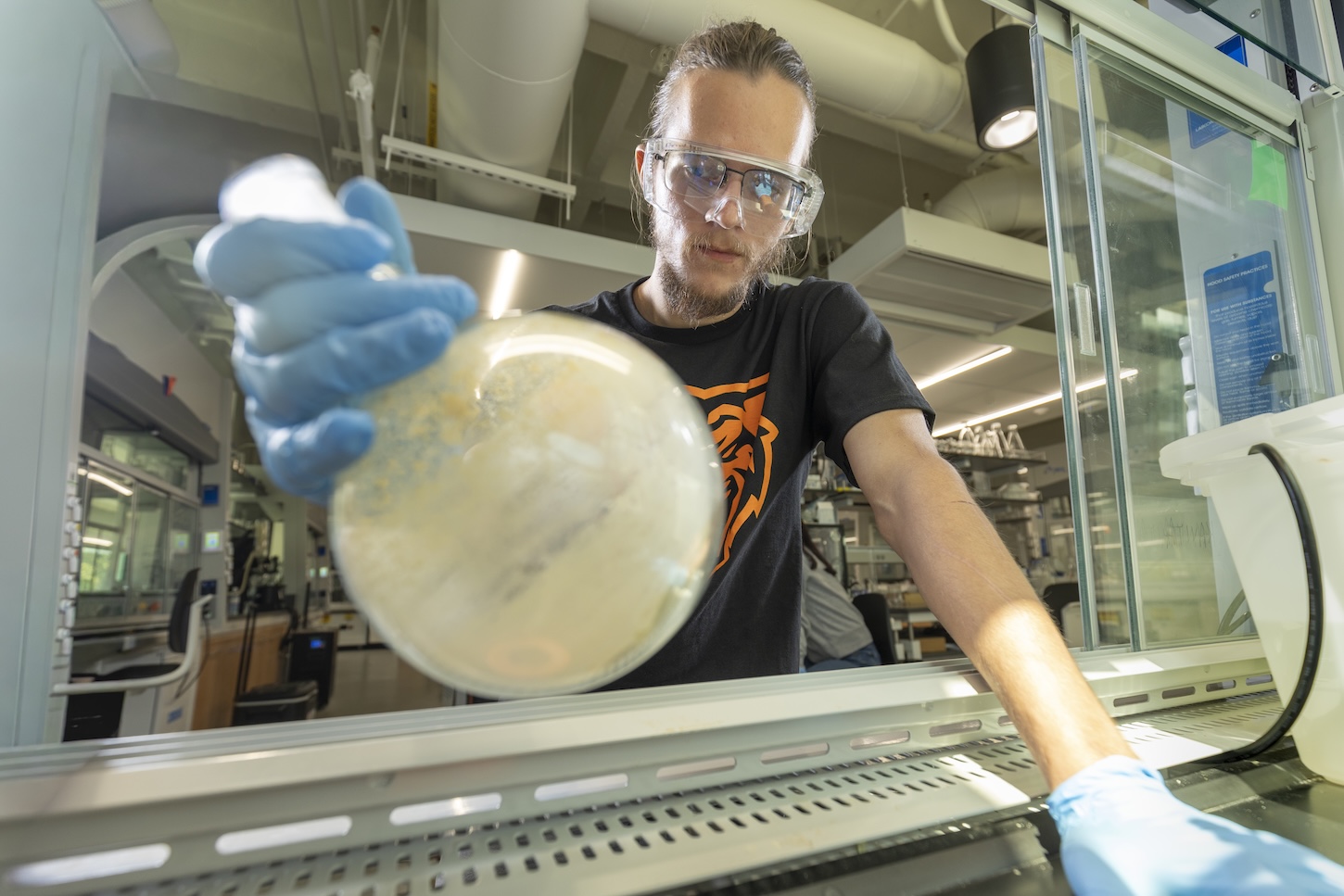
The old saying of "one man's trash is another man's treasure" may prove true when it comes to finding more of the rare earth elements in much of the technology we use each day thanks to Idaho State University scientists.
Rare earth elements are a group of 17 elements used to produce everything from smartphones and consumer electronics to wind turbines, electric vehicles, and more. Found in relative abundance despite the misnomer of a name–one rare earth, cerium, is more abundant than copper–the catch is they’re often found in not-easy-to-get-at-and-extract deposits like gold or silver, only in trace amounts.
“All 17 elements co-occur in low concentrations within host minerals like bastnäsite and monazite,” said Kavita Sharma, assistant professor in the Department of Biomedical Sciences. “Refining them is an immense challenge because REEs share nearly identical atomic structures, requiring complex, repetitive steps to separate individual elements. The process is further complicated by radioactive contaminants like thorium in the host ore and the massive amounts of toxic acids required for extraction.”
One place rare earth elements can be found in large quantities, and easily, is the proverbial dumpster. Mine tailings–a liquid slurry of leftover bits of rock and chemicals after the valuable minerals have been extracted–and electronic waste–better known as e-waste, and including everything from appliances to televisions, toys, and more–contain a trove of the precious elements.
“Global waste streams represent a massive secondary reserve of critical metals, with mine tailings alone holding an estimated 93 million tons of rare earth oxides,” said Sharma, “Discarded e-waste contains an even richer urban mine, where key electronic components contain target rare earth elements at concentrations hundreds to thousands of times higher than natural ore.”
Thanks to a grant through the Idaho State Board of Education Higher Education Research Council’s Idaho Global Entrepreneurial Mission Grant program, Sharma and Cori Jenkins, associate professor of chemistry at ISU, are looking to develop polymers–long chains of molecules–that can bind themselves to rare earth elements, making them easier to extract. Once the polymer-bound elements are extracted, the polymer is stripped away, leaving just the rare earth elements behind. It’s familiar territory for Jenkins, who, in 2022, published her and her colleagues’ work on a polymer that can bind to gold and silver. Like her previous polymer, Jenkins is developing a sulfur-based one targeting antimony.
“Over the past few years we have altered the sulfur-rich polymer structure and worked to understand how these materials are interacting with dissolved metal ions,” said Jenkins. “These studies have helped us design new polymers with extremely high gold-binding capacity and enhanced selectivity. Moving forward, we plan to adapt what we have learned to target antimony.”
At the same time, Sharma is working on creating a polymer that targets neodymium using one of Idaho and the Intermountain West’s most common plants: sagebrush.
“Sagebrush offers a double advantage for critical mineral recovery: it is an abundant, low-cost resource, and its natural chemical constituents—sesquiterpene lactones—serve as an ideal molecular scaffold for tailored rare-earth extraction,” Sharma said. “This enables the resulting biopolymer to be specifically engineered to grab and hold neodymium ions, acting as a selective molecular sponge for recovering high-value neodymium from waste streams.”
“Working on the project has given me the opportunity to test how effectively I can make what I have learned through coursework practical,” said Angelo Mayer, a senior at ISU majoring in biochemistry. “More specifically, I think making use of underutilized natural products like sagebrush to make new materials connects science to everyday things in a way that is sometimes hard to see otherwise.”
Recovering rare earth elements could turn waste streams into revenue streams for industry. An estimated 8.85 to 14.4 billion tons of mine tailings are produced globally every year, according to a United Nations report. Meanwhile, another UN report pegs annual e-waste generation at 62 million tons. In Idaho, Perpetua Resources, a company “focused on the exploration, site restoration, and redevelopment of gold-antimony-silver deposits in the Stibnite-Yellow Pine district of central Idaho,” has been helping out with the project by providing water samples impacted by previous mining and tailings. Over the summer, Perpetua hosted researchers and students at the mine site for a field visit where they collected samples and got a first-hand look at modern mining operations.
“It was a pleasure to introduce the students to a bit of environmental fieldwork and to get a boots-on-the-ground perspective of the Stibnite Gold Project,” said Blaine Serrin, local engagement coordinator for Perpetua Resources.
Starting this fall, five students are also working on the project through the Recovery of Idaho’s Strategic Elements course at ISU, funded by the Idaho Community-engaged Resilience for Energy-Water Systems project. During the class, students will receive “hands-on training in polymer synthesis and critical mineral extraction,” and learn how to operate the many scientific instruments needed to complete their tasks.
“I'm excited to be a part of this research project because it feels very rewarding to contribute towards solutions for growing challenges,” said Kira Torrez, a fourth-year student majoring in chemistry.
If the polymers prove successful, the research team hopes to scale them up and have them integrated into companies' existing waste workflows.
“This project combines education, research, and economic development,” said Jenkins. “Our long-term goal is to establish a circular materials economy that increases Idaho’s competitiveness, attracts private investment, and ensures that economic and environmental benefits stay within the state.”
For more information on ISU’s Department of Chemistry, visit isu.edu/chem.
More on ISU’s Department of Biomedical Sciences can be found at isu.edu/pharmacy/biomedical-sciences.
Categories: