
First AI Sciences Major at Idaho State Blazes His Own Trail
September 14, 2026
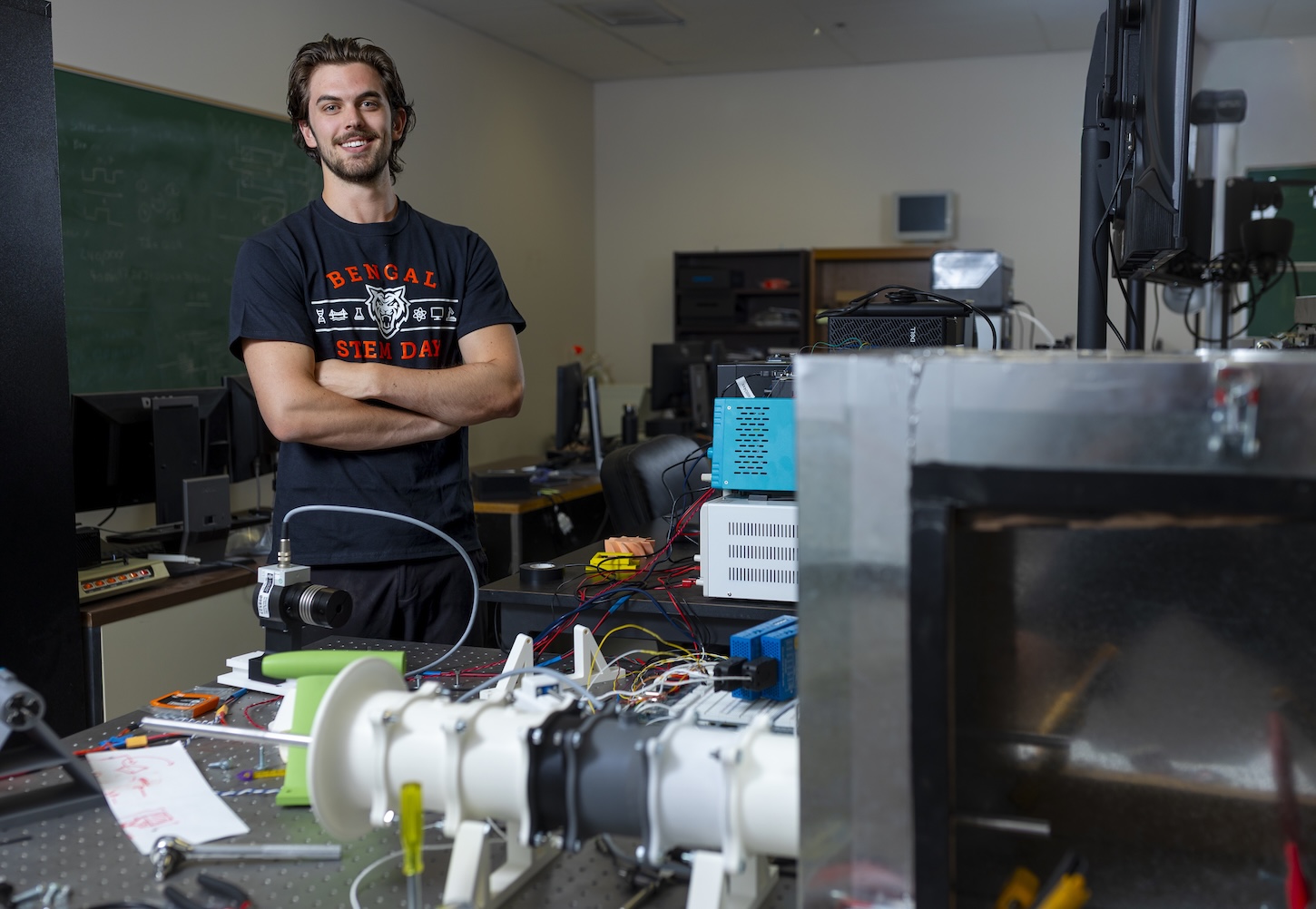
Before he set foot on Idaho State University’s Pocatello campus, Christian Done had never attended a class.
“I was basically homeschooled,” said Done. “Everything was basically self-taught, and I took some standardized tests at 16 to get my high school diploma.”
He's traveled a few miles on the route to the classroom seats he now occupies at ISU. Born in California, Done moved with his parents to New Zealand when he was a year old. Before he turned 16, he moved back to California, and after graduating early with a 4.26 GPA, he found himself in Northern Idaho.
“My brother bought some property, and we went to build a log cabin in the woods there,” said Done. “We didn’t have cell service, and I was completely isolated; it was way off in the sticks.”
After the cabin was complete, he found a job working as a diesel mechanic.
“I always liked working with my hands; it was a natural interest through working on my own vehicles, so I applied to different mechanic shops,” said Done. “I took the job knowing it wasn’t what I wanted to do with my life.”
As a kid, Done harbored a dream of becoming a “Lego designer,” but as he got older, the dream made what he calls a “natural progression” to wanting to go into an engineering field. Ten months went by, and Done decided it was time to move on from his work in the shop.
“I couldn’t conceptualize working as a mechanic for the rest of my life,” Done said.
Done started surveying his options. Given his homeschooled past and his do-it-yourself ethos, Done first considered attending an online university to major in electronics engineering, but a question he asked one of their representatives put him off the idea.
“I asked them if they were accredited by ABET,” said Done. “They said they had their own accreditation. I wasn’t willing to get my degree and not have it be accredited.”
To an untrained ear, being accredited by ABET may not seem like much, but in the world of engineers, it’s the highest stamp of approval for an engineering program. For programs to be accredited–like ISU’s–the program must demonstrate it’s promoting “best practices in education,” directly involving “faculty and staff in self-assessment and continuous quality improvement processes,” and is basing the program on “learning outcomes” and not “teaching inputs,” and more.
“ABET accreditation indicates to students that a degree program meets the global standard for technical education in their field,” said Mary Lou Dunzik-Gougar, professor of nuclear engineering and associate dean in ISU’s College of Science and Engineering, as well as an ABET evaluator for the past 15 years. “The team of evaluators that reviews a program every six years is comprised of volunteers from industry and academia.”
After receiving the non-answer of an answer from the online institution, Done restarted his search, focusing on universities with ABET’s endorsement.
“I analyzed it from the ground up, and I found ISU,” said Done.
Also factoring into his decision to take a deeper look at Idaho State was the appeal of in-state tuition, plus, not being charged more per credit for taking more than 12 credits as a full-time student was a big draw.
“It created an idea in my mind that the school is on my side,” said Done.
That said, Done still had his own reservations about taking the personal leap of attending school in person.
“I was terrified of doing it,” Done said. “I’m of the mindset that if you’re terrified of doing it, it’s probably the right move to make. I was scared of going to a university, I was used to learning online and not in a classroom with other students, and having a relationship with a teacher was not something I was used to or even conceptualized.”
Now came the task of looking into a major to get started in. Another search online, and he landed on one: nuclear.
“In all honesty, the real reason was it sounded cool,” explains Done. “I literally googled ‘engineering majors,’ and I’d never even heard of nuclear. I’d heard of mechanical, civil, aerospace–the typical majors–and I saw nuclear engineering and thought, ‘That sounds super cool.’ I had positive thoughts about nuclear energy previously and thought it was an underappreciated asset that the human race has, and it made me wonder if I could contribute.”
His own anxieties aside, and with some prodding from his brother, Done sent an email to Chad Pope, professor of nuclear engineering at ISU, seeking some basic information about the program.
“He sent me an email back, and I never responded to it because I felt bad,” Done said. “In my mind, he’s a Ph.D. in nuclear engineering, and I’m just some rinky-dink guy. I didn’t want to take up any more of his time, so I was like I’ll just send it and joined.”
In Spring 2024, Done arrived on campus in Pocatello and started his studies. Early on, he met someone he quickly calls his best friend and mentor: Jaden Palmer.
“We became very close due to me joining the nuclear program,” said Done.
Palmer took Done under his proverbial wing, helping him secure an undergraduate research position in an on-campus lab, guiding him through the application process and his acceptance into the University Honors Program, and advising him to pursue a second major in mechanical engineering.
“Jaden has been the biggest factor in my university experience by far,” said Done. “I’m very grateful to the mentors I’ve had, my professors, and the opportunities that have been provided to me, but the greatest asset I’ve gained in coming to ISU is my friend Jaden.”
“During my time at ISU, I’ve never had a better friend than Christian,” said Palmer. “From the very beginning, when I first met him, it was clear that he carried a large sense of humility, groundedness, and discipline that is very rare in an individual.”
It was Palmer who introduced Done to the research side of the undergraduate experience at Idaho State. Palmer offered to help him land a position in ISU’s Department of Mechanical and Measurement & Control Engineering. The first lab Done joined was one headed up by Marco Schoen, professor of mechanical engineering, where they are focusing on using artificial intelligence and machine learning to design customized prosthetics. They’re also using augmented reality to help train people in the use of the artificial body part.
“When I joined research, there was obviously an inferiority complex, like I’m just a home-schooled kid who hasn’t been in academia for a while and never even thought of research,” Done said. “Dr. Schoen was exceptionally nice and very welcoming.”
“Christian quickly immersed himself in mastering the necessary programming languages and project concepts, soon contributing to the development of an augmented reality–based AI prosthetic,” Schoen said. “Today, he serves as a mentor and plays a key role in bringing new students into the research center’s many projects.”
He’s also got his hands into other projects across campus, ranging from helping to assemble the control rods for AGN-201, ISU’s on-campus nuclear reactor, optimizing web search algorithms, and increasing fuel economy for jet engines, to name a few. Plus, Done serves as President for both the MCERC Club and the Kinematica Club.
“I feel bad leaving projects, that's why I keep collecting them like Pokémon,” said Done. “If any professor approaches me and says, ‘Hey, would you be interested?' I’m like, ‘Absolutely.’”
Now a sophomore, Done was one of five Bengals to receive a scholarship from the Department of Energy's University Nuclear Leadership Program. The highly competitive program awards $5,000 scholarships to students "receiving training as nuclear-energy-related technicians" and $10,000 to those "pursuing a nuclear-energy-related degree." Before he applied, he’d never heard about the scholarship and did so at the urging of Palmer and another friend, Chris Gundersen.
“I kind of did it out of peer pressure, I had that much respect for Jaden and Chris,” Done said. “Getting the scholarship meant a lot and gave me the thought that I can do well.”
“Any opportunity that has been provided to Christian has been fully matched by his hard-working nature and willingness to learn and contribute quickly,” Palmer said. “I am so glad to be able to call Christian a friend, and I know that every accomplishment and opportunity he attains is fully deserved."
“Any opportunity that has been provided to Christian has been fully matched by his hard-working nature and willingness to learn and contribute quickly,” Palmer said. “I am so glad to be able to call Christian a friend, and I know that every accomplishment and opportunity he attains is fully deserved."
In the spring of 2026, Done decided to switch majors from nuclear engineering to artificial intelligence sciences, becoming the first student to major in the degree at ISU. The newly offered bachelor’s is a collaboration between the mathematics & statistics and computer science departments, and equips students with the theoretical background and skills needed for the growing field.
“Looking back at the work I’d already been doing–machine learning for prosthetics, optimizing search algorithms, and physics-informed neural networks–it was all AI and mathematics,” said Done. “I was doing the degree before it existed, and when ISU launched the new degree, it allowed for more alignment with where I am and where I want to go.”
Done says he still plans to follow Palmer to the Tarheel State and pursue a doctorate in nuclear engineering at North Carolina State University. After completing his studies, Done says he and Palmer may start their own consulting firm, or he might follow in Pope's footsteps and enter academia. In the meantime, though, Done says he wants to help the students like him who had some apprehension about college but still made the leap.
“I was terrified just like you; it’s perfectly understandable,” Done said. “It’s pretty tough learning how to do school for people who have no experience, and even those who have experience, college is a scary concept. I want to alleviate a little bit of that burden and that fear, and help them with those lessons on a personal level.”
Prospective students can schedule a campus tour at isu.edu/visit.
Categories:
College of Science and EngineeringStudent LifeUniversity News